
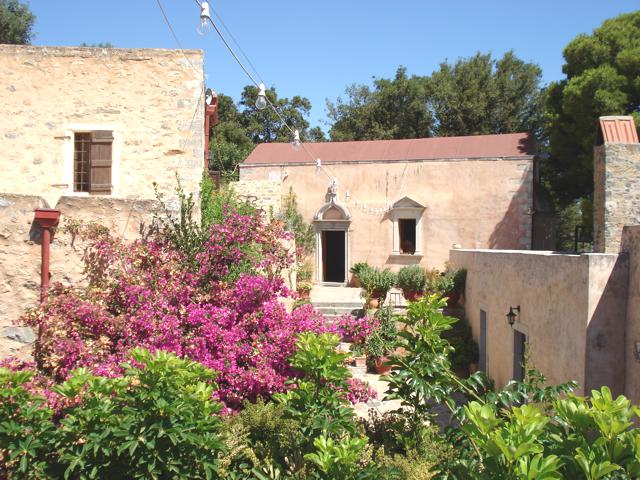
 The Holy Monastery of Kremasta, one of the most historic monasteries of Crete, rises on the north-eastern slope of Mount Kavalaras, near the village of Vryses Merambellou, at an altitude of 397 m and about two kilometres from Neapoli. A saving ark, sent by God to a site chosen for its natural beauty and lush vegetation. Built upon the rocks, suspended as if hanging in the air, it is a fragrant flower in a landscape like a picturesque painting not made by human hands. A small paradise with running spring waters, surrounded by towering, centuries-old holm oaks, pines and cypresses. The song of the birds reaches the pilgrims' ears like angelic chanting, amid its heavenly quiet and tranquillity. One might say it is perhaps the only place in the region that combines so much beauty with such harmony. God blessed it and graced it, offering a gift of inestimable value to our land. Kremasta is a place blessed by God and privileged by nature.
The name "Kremasta", meaning "hanging", comes precisely from this position, since from afar the Monastery appears to hang from the hillside.
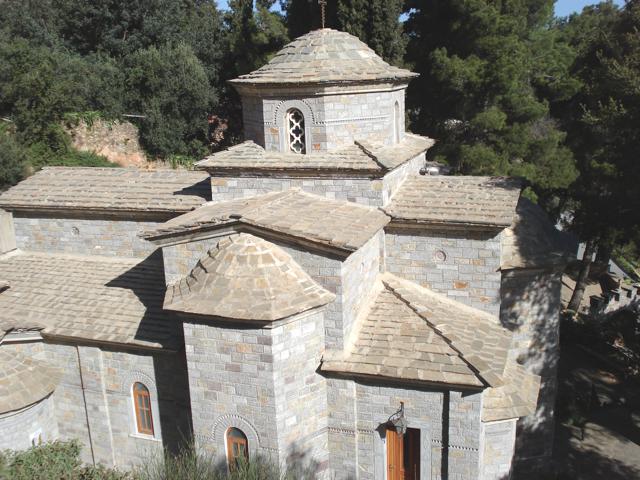 The katholikon (main church) of the Monastery is dedicated to the Holy Taxiarchs and celebrates its feast on 8 November. It dominates the northern side of the complex and belongs to the architectural type of the single-nave, barrel-vaulted church. It is not a large katholikon, and despite the fine dressed stones of its door and windows it does not impress by its grandeur; it edifies, rather, by its humility.
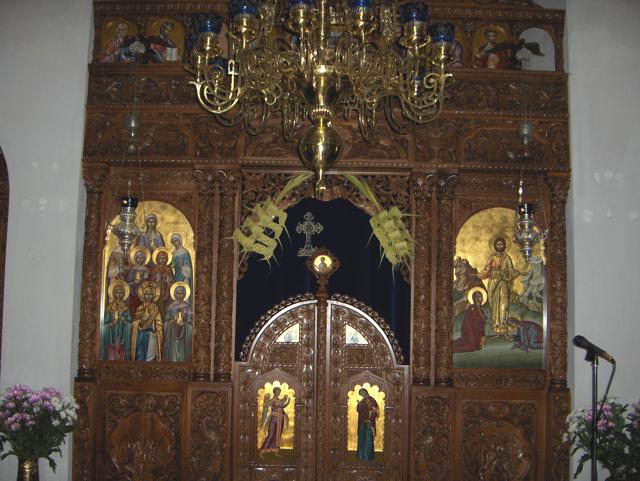
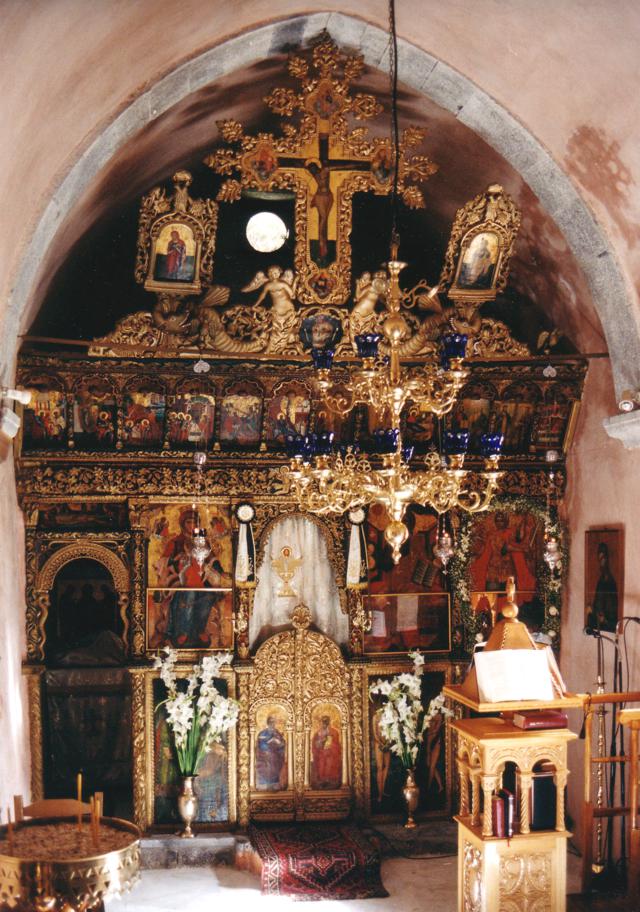 The iconostasis of the Monastery's katholikon is the finest ornament of the church, being a wood carving of outstanding craftsmanship. It is thought to have been made around 1866 and is the work of Ioannis Makrakis, a wood carver of that period. After the restoration of the Monastery the iconostasis was conserved, as were its icons.
 The carved founder's inscription on the lintel of the church entrance testifies that the Monastery was founded at the end of the 16th century, in 1593, at the close of the Venetian period, and that its founder was Metrophanes Agapitos.
1593. THIS CHURCH OF THE TAXIARCH WAS BUILT BY THE HIEROMONK METROPHANES AGAPITOS
The founder of the Monastery erected it by giving to it his entire personal fortune. In the katholikon, of particular interest is the decoration of the stone slab of the Holy Altar, with carved vine leaves, a bust of Christ and the inscription "April 1622, built by the Hieromonk Nikephoros Anifantis".
The main phase of the Monastery's construction lasted from 1593 to 1622. Because of its position, the monastic complex has a fortress-like character, with two main entrances on the southern side corresponding to the different functions of the buildings that gradually took shape. One entrance serves only for access to the courtyard, the cells and the church, while the other served agricultural activities: the olive press, the bakery, the stables and so on.
The Monastery of Kremasta was one of the wealthiest monasteries not only of the Prefecture of Lasithi but of the whole of Crete, which facilitated its charitable work, the upkeep of its school and its financial support for the rebuilding of churches and schools in the surrounding villages. The primary school of the village of Vryses is built on land donated by the Monastery.