
Its history is interwoven with the vicissitudes of Crete and of our Nation from the Venetian period to the present day (its position near the main road was the reason it suffered many attacks and was destroyed by the pirate Barbarossa).
Under Ottoman rule, too, the Monastery suffered greatly. The Turks knew that the cassock was a banner that electrified and inflamed the souls of the struggling people, and that the clergy were always at the forefront, fighting for freedom at every personal sacrifice; for this reason they plundered and desecrated the Monastery, as the archive of Timotheos Veneris, Metropolitan of Crete, informs us. Yet the Monastery of Kremasta endured and managed to develop rich national activity, becoming a centre of revolutionary operations as well as of education. With zeal and self-sacrifice, its devout clergy succeeded in founding a secret school and later a spiritual centre, thus playing an important role in the education of the province of Merambello. They printed books, encouraged, cared for and strengthened the weak, and protected the unlettered Orthodox population. Secretly, silently, far from the eyes of the aghas, and later a little more openly, taking care not to provoke the conqueror, they passed on light, hope and life to unenslaved souls. Beside the monk, the hopes of the Greek child came alive again. He armed himself with confidence in the strength and abilities of his people. Now he believed with certainty that the long-awaited day would not be slow in coming. And indeed time passed, and as it passed the Greeks grew ever bolder. With the tolerance of the Turks, the monks now gathered the children in certain parts of the Monastery, in spacious cells or in the courtyard, and taught them.
The Monastery of Kremasta was repeatedly subjected to the destructive fury of the Turks. In 1869 the monks gathered all the Monastery's relics and books and hid them in a cave to save them. Of these only the vessels survived, while the books were destroyed by the damp. Among them was a rare 10th-century manuscript Gospel on parchment, which unfortunately disappeared later.
Foundation of a public primary school at the Monastery
Later, in 1848, the devout Dorotheos, first Bishop of Petra, founded at the Monastery of Kremasta the only primary school in the district. Distinguished men of the region taught there, and among its graduates were figures such as Meletios Chlapoutakis, Bishop of Petra, who also taught there, and the Hieromonk Grigorios Lymbridis, who held the title of Protosyncellus. It was a happy coincidence that two educated clergymen were found to teach at the monastery in a period when literate clergy were very few. The distinguished man of letters Dialynomichalis also taught at this school. In general it gave the Nation educated men, priests and teachers. From this school arose a tradition of spiritual cultivation among the young people of the region and of their turn towards learning. The space in which the secret school operated was used during the Italian-German occupation as a hideout for British counter-intelligence agents of the resistance. Allied headquarters honoured the Monastery for these services.
Meletios Chlapoutakis, Bishop of Petra, the soul of revolutionary Merambello, 1866-1869
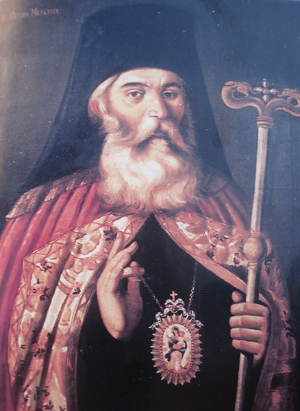 A few words should be said here about the ardent patriot and blameless hierarch Meletios Chlapoutakis, Bishop of Petra, from the village of Vryses, who served as abbot of the Monastery of Kremasta. It was he who raised the flag of the Revolution in Merambello and made the ideal of "Faith and Fatherland" his sacred emblem. It was he whom the fighters proclaimed leader of the revolution of 1866-69.
 Bishop Meletios Chlapoutakis of Petra belongs to the company of the eminent hierarchs of our Church and Nation. Because of his revolutionary activity the Turks called him "Meletebey". When the Sultan learned of his national activity, he condemned him "to death by hanging".
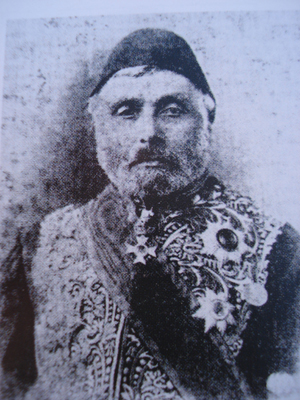
Following the efforts of Kostis Adosidis Pasha, Governor of Lasithi, and of the then Patriarch Joachim, the Sultan revoked the firman of condemnation in 1868.
Meletios Chlapoutakis remained for five years, 1869-1874, at the Monastery of Kremasta together with Adosidis Pasha; their aim was to work together for the spiritual and cultural advancement of the Christians. The fruit of this collaboration was the construction of the old Gymnasium of Neapoli, originally intended as a hospital, of the courthouse and other public buildings, as well as the town plan of Neapoli, works that survive to this day.
Administrative centre of the Prefecture of Lasithi
After 1868 the Sublime Porte appointed as Governor of the Prefecture of Lasithi the Christian Kostis Adosidis Pasha, a native of Constantinople who enjoyed the favour of the Vizier, as the man best suited to pacify rebellious Lasithi. As his seat he chose the new village (present-day Neapoli), and after a stay of two or three months he moved his residence to the picturesque Monastery of Kremasta. There he built particularly grand apartments, constructed a drainage system and the fountain at the entrance of the Monastery, whose facade the Italians demolished when they turned it into a prison during the occupation. It should also be noted that Kostis Adosidis is for Neapoli a great benefactor and reformer, since his works form a large part of its history and of its cultural heritage.
Lower Agricultural School
The Monastery's contribution continued after the Ottoman period: its cells housed the Lower Agricultural School, and its lands hosted agronomist teachers and farmer students. In 1931 an Agricultural School was founded at the Monastery, attended by the residents of the Neapoli Orphanage, which was half converted into an Agricultural Orphanage. The Monastery ceded its lands to the Agricultural Service and became a model farm for the district. The farmers of Merambello thus came to know many trees previously unknown in the district, fruit-bearing and ornamental, such as persimmons and eucalyptus. For the first time in Crete, Italian agronomists taught olive pruning at this model farm. They also taught arboriculture, horticulture, beekeeping, sericulture and more.
The Monastery's national contribution during the Italian-German occupation
During the Italian-German occupation the Monastery of Kremasta played an important role for the region. At first it housed the orphans of the National Orphanage of Lasithi, since the Italians had seized all public service buildings and left them homeless. Immediately after the occupation of Crete the National Resistance began, and a group of British commandos chose the Monastery as the base for their meetings with Greek patriots. From there they coordinated all operations for sabotage against the enemy. The Monastery sheltered and supplied the British, contributing decisively to the blows struck against the occupiers. For this reason it was awarded an "honourable mention" by the British Embassy.
After the Italian-German occupation
After the end of the occupation the Monastery had suffered great looting and destruction. Nevertheless it once again proved a valuable helper, since it housed many children from the remote villages so that they could learn letters and trades, as in Neapoli and Agios Nikolaos there was no suitable infrastructure to accommodate the children of distant villages, owing to the poverty and deprivation caused by the war. It succeeded once more, and under the protection of the Archangels it offered the last surplus of its love, even though, with the destruction it had suffered in the Second World War and the decimation of a large part of its property since 1900 (by a State law, on account of the small number of monks the Monastery had; in 1935 it was declared a protected monastery, but with minimal property), it had already begun to withdraw from the arena of charitable activity and to decline.